
Does My Small Business Need a Website?
Facebook and Google profiles help, but they aren't enough. Here's why Edmonton-area small businesses still need their own website in 2026.

Think about the last time you needed a plumber, a restaurant or an accountant. You probably pulled out your phone and searched Google. You looked at the map results, checked a few ratings and then tapped through to a website or two before you called anyone. That’s how most local customers find businesses today: a Google search, then the map pack, then the website. If your business doesn’t have a website at that last step, you’re relying on everything before it to do all the convincing. Here’s why your own website still matters, even if you already have Facebook and a Google Business Profile.
”I Already Have Facebook and Google.” Why That Isn’t Enough
I hear this a lot, and I understand it. A Facebook page and a Google Business Profile are free, and they do help. You should absolutely have both. But they have limits.
- You don’t own them. Facebook and Google set the rules. They can change the layout, limit who sees your posts or suspend your page, and you have little say. Your website is yours.
- They all look the same. Every Google profile and Facebook page uses the same layout as your competitors’. There’s little room to show what makes you different.
- There’s limited space to explain. A Google profile shows your hours, location, photos and reviews. It doesn’t have room to explain each service, show detailed past projects or answer the questions customers have before they call.
- Not everyone uses Facebook. Plenty of customers don’t have an account or don’t use it to find businesses. A website works for anyone with a browser.
- Google rewards websites. A Google Business Profile that links to a strong website gives Google more information about your business. That helps you show up in more searches.
Think of your Google profile and Facebook page as signs pointing to your business. Your website is the business itself, where people go to decide whether to hire you.
A Website Builds Trust Before Anyone Calls
People check out a business before they contact it. They want to know you’re real, that you’re good at what you do and that you’re the right fit. A professional website answers those questions before they ever pick up the phone.
Your website is the place to show:
- Real photos of your work, your team and your location.
- Reviews and testimonials from happy customers.
- Your experience, certifications and memberships.
- Clear details about what you do, where you work and how to reach you.
The opposite is true too. A website that looks outdated, broken or thrown together can make people wonder whether the business is the same. That’s especially true for trades and home services, where you’re asking people to let you into their home. I talk about how a weak website costs you trust in my post on whether AI will replace web designers.
A Website Helps You Show Up on Google
Without a website, you’re mostly limited to the map results and your Google profile. With one, you can show up in the regular search results too, and for many more searches.
A website gives you a page for each service you offer and each area you serve. A roofer can have pages for roof repair, roof replacement and eavestroughs. A business that serves more than one community can have a page for each one. Each page is another chance to match what someone types into Google.
I do this for my own business. Besides my main Edmonton pages, I have dedicated pages for web design in St. Albert, web design in Sherwood Park and web design in Leduc, because people in those communities search for local businesses.
There’s a lot more to ranking well than having pages, though. I walk through my whole process in how I get Edmonton business websites ranking on Google.
It Answers Questions 24/7
Your phone isn’t always on, but your website is. Customers search at all hours: late at night after the kids are in bed, early in the morning or on the weekend. A good website answers their questions whenever they ask them:
- What services do you offer?
- Do you serve my area?
- How much does it roughly cost, or what affects the price?
- How long will it take?
- What do other customers say about you?
- How do I book or get a quote?
You can’t answer all of that in a Google profile or a Facebook post. A website gives you room to explain your services properly, show examples of your work and set expectations before anyone contacts you. That also means the people who do call are better informed and more likely to be a good fit.
An FAQ section is a simple way to answer common questions up front. Every question your website answers is one less phone call for you, and one less reason for a customer to look elsewhere.
It Turns Visitors Into Calls
A website isn’t just an online brochure. Its real job is to turn visitors into customers. That means making it easy and obvious to take the next step: calling, requesting a quote, booking an appointment or placing an order.
The best small business websites make this simple:
- A phone number at the top of every page that can be tapped to call on mobile.
- Clear buttons like “Get a Free Quote” or “Book Now” instead of a vague “Learn More.”
- A short contact form that doesn’t ask for too much.
- Calls to action after each section, so visitors don’t have to scroll back up to find one.
These small details make a real difference to how many visitors become customers. Here’s more on how to write a call to action that converts.
Real Example
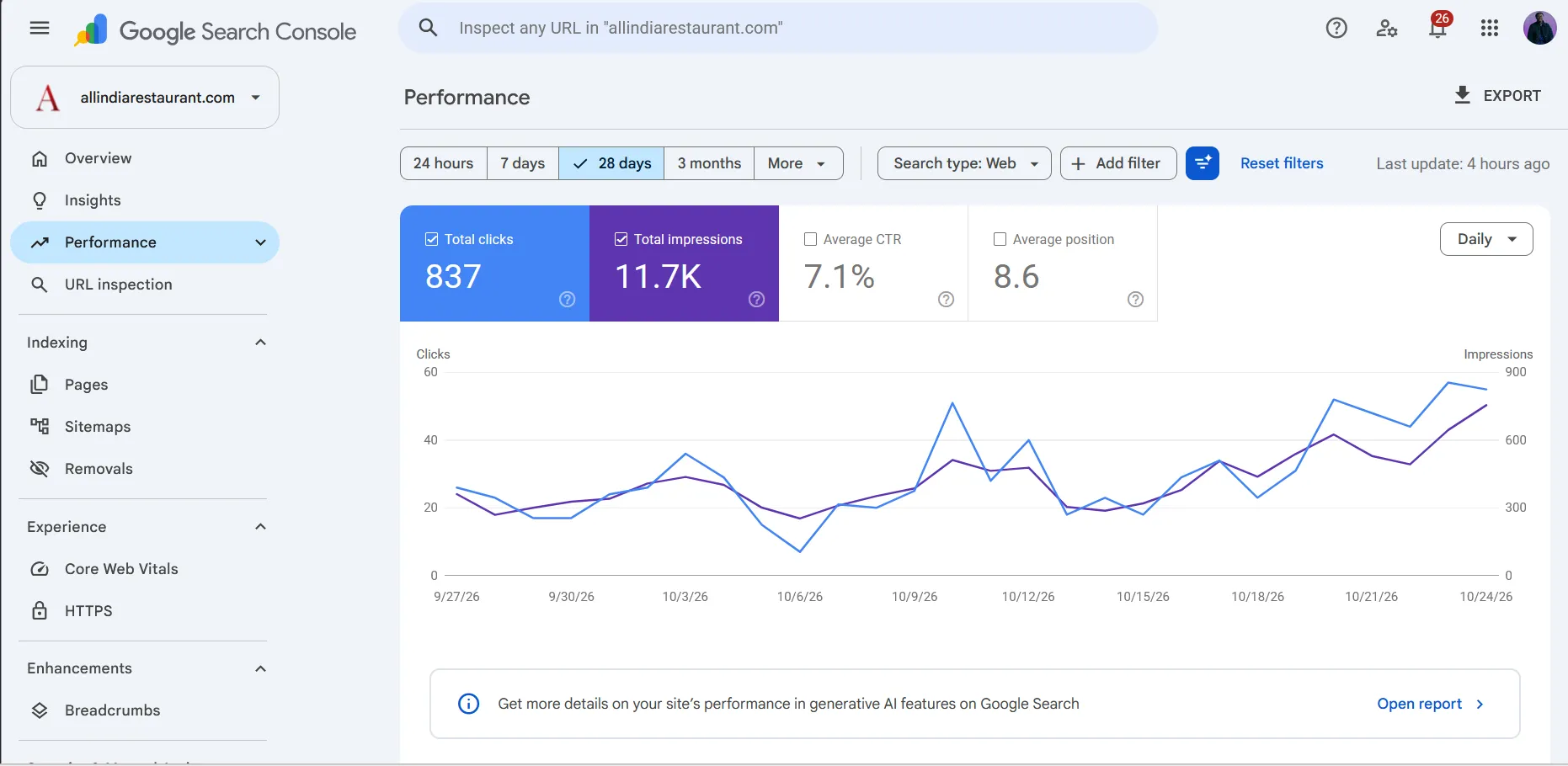
A couple of years ago, I redesigned the website for All India Restaurant & Sweets. The restaurant had an old-school site that didn’t reflect the quality of the food. I took it to a modern restaurant website with a clear menu, strong photos and an easy way to order.
Today the site gets about 11,000 impressions a month in Google search and 837 visitors a month. That means the restaurant shows up in front of potential customers more than 10,000 times every month, and hundreds of people click through to learn more. No Facebook page could do that on its own.
What If I’m Just Getting Started?
You don’t need a big, expensive website on day one. A small site with a home page, a page for your main services and a clear way to contact you is a solid start. You can add pages for each service and area as your business grows.
What matters most is that the site looks professional, works well on phones, loads quickly and makes it easy to get in touch. A simple site that does those things well will serve you better than a big one that does them poorly.
So, Does Your Business Need a Website?
For almost every small business, yes. Facebook and Google profiles are a good start, but a website is the one place online that you own and control. It builds trust, helps you show up on Google, answers questions around the clock and turns visitors into calls.
If you’re not sure where to start, I’d be happy to help. Take a look at my web design and development services in Edmonton, or get a quote and I’ll tell you what your business needs.
Frequently Asked Questions
How much does a small business website cost?
My custom websites start at $2,500 for a 5-page site with SEO setup, a CMS you can edit yourself and 30 days of post-launch support. If you'd rather spread the cost, I also offer a monthly option from $350 a month that includes hosting and maintenance. Online stores start at $5,000.
Is a one-page site enough?
It can be when you're just starting out or offer one simple service. But a one-page site makes it hard to rank on Google for more than one thing. Separate pages for each main service and each area you serve give you far more chances to show up in search, and give customers the detail they need.
How long does it take?
Most small business websites I build take 2 to 3 weeks from start to launch. Larger sites with more pages, custom features or an online store usually take 4 to 6 weeks. Having your content and photos ready is the biggest thing that keeps a project on schedule.